Deliberative Diversity
The deliberative Exposure Diversity (EPD) algorithm implements a deliberative diversity model by providing news articles from a wide range of topics and viewpoints. EPD emphasizes party visibility, particularly minority parties', to enhance public awareness and foster a more inclusive understanding of political discourse.
For the code, please see the EPD implementation in the repository.
INFO
This tutorial outlines part of the workflow for the Informfully Recommenders repository. The Recommenders Pipeline provides an overview of all components. And you can look at the Tutorial Notebook for hands-on examples of everything outlined here.
Algorithm Overview
EPD is based on the articles of the majority and minority parties, as well as the user's attributes. It requires researchers to pre-configure the party attributes and the user's political type. To that end, EPD assigns users to one of three conditions at the beginning of an experiment:
- exposed to news on the majority parties,
- exposed to minority party news, or
- exposed to other political news. The Figure below shows an overview of how EPD builds the recommendation list one slide at a time.
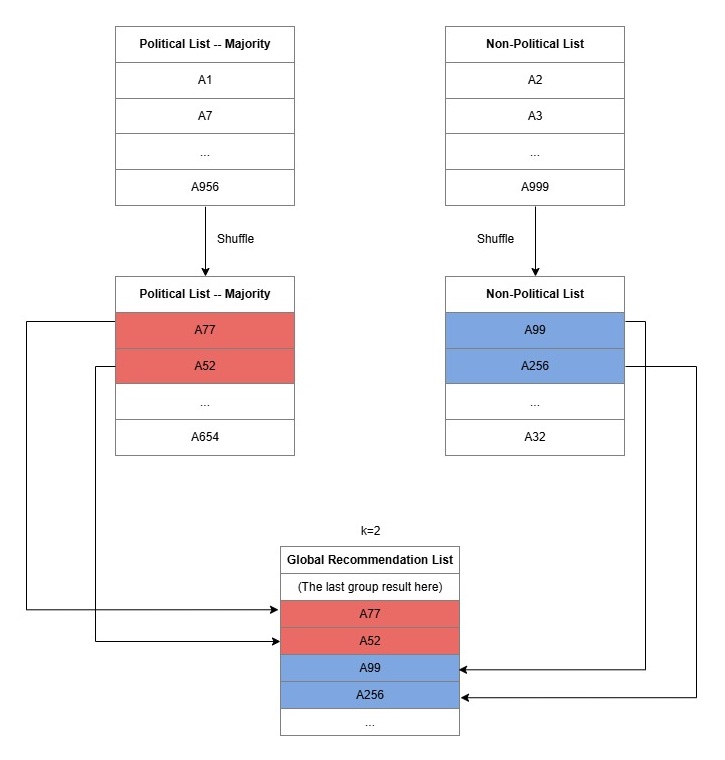
The continuous exposure lengths of majority party articles, minority party articles, political articles, and non-political articles are controlled by parameters to increase the diversity of recommendation results. In each news recommendation list, articles with both majority and minority views are displayed in the order the user sets. For example, with a list size of 20 and a slice value of 2, users in the minority party condition receive two articles from the minority party, followed by two non-political articles. This process is repeated until 20 articles have been added to the feed. The news supply to EPD assumes items are from the most recent day. Articles get shuffled before being added to a recommendation list. This is done to avoid any outlet-based clustering, as articles are scraped one outlet at a time.
Open Parameters
Details can be found in the Configuration File.
- name: string, default: 'EPD'. The name of the recommender model.
- articles_collection: list. The list of entire articles, including the article's political references.
- political_type_dict: dict. The dictionary of political classes, keys are indices, values are political types of articles.
- num_items: int. The number of items(here are articles) in one experiment.
- k: int, optional, default: 3. The number of political and non-political articles added to the recommendation collection each time.
- pageWidth: int, optional, default: 24. The maximum number of articles added for each user group.
- trainable: boolean, optional, default: True. When False, the model is not trained, and Cornac assumes it is already pre-trained. (U and V are not 'None'.)
- verbose: boolean, optional, default: False.When 'True', running logs are displayed.
Article Classification
Articles in the majority party's news must mention at least one member of the majority/governing party, and they must not mention any minority or opposition party. Minority party news features at least one minority/opposition party. Other political news consists of articles on various political topics, without mentioning any specific majority or minority parties or foreign political parties. The list size of EPD determined the number of recommended articles, with a slice value used to group and interleave non-political articles.
Source
Deliberative Diversity for News Recommendations - Operationalization and Experimental User Study, Heitz et al., Proceedings of the 17th ACM Conference on Recommender Systems, 813–819, 2023.
   @inproceedings{heitz2023deliberative,
      title={Deliberative Diversity for News Recommendations: Operationalization and Experimental User Study},
      author={Heitz, Lucien and Lischka, Juliane A and Abdullah, Rana and Laugwitz, Laura and Meyer, Hendrik and Bernstein, Abraham},
      booktitle={Proceedings of the 17th ACM Conference on Recommender Systems},
      pages={813--819},
      year={2023}
   }